
Our Campaign and Call to Action
A hospital caused Wesley’s kidney injury, concealed it, and retaliated using their securitization program and in-house collection agency until we lost our coaching business and housing. We’re two self-represented litigants up against three corporate law firms who refuse to release Wesley’s medical records. We manage the cases from inside a failing camper — and we’re not quitting.
Donations:
We are putting our expenses on a credit card and on our line of credit. If you would like to help, we will be using revenue for Wesley’s medical expenses, the cases, and to purchase an RV and land. We can’t afford a house or rent, so we will continue camping, but we need property so we don’t have to wander finding places to park.
You can donate via CashApp: $kuduzujungle or by mail: 200 W. Spring St., #528, Oliver Springs, TN 37840, or via our GiveSendGo campaign.
We are asking for others to get involved!
This case is bigger than two self-represented plaintiffs. It’s about whether federal law means what it says — and whether hospitals can avoid accountability for the patients they turn away. Hospitals can use the courts in the Sixth Circuit to escape accountability because the courts can block access to evidence using Cleland v Bronson. That’s what the District Court did to us. It’s as if the District Court had a personal interest in the outcome of our case, and aided the defendants to prevent discovery.
Wherever you stand, there is a role for you here, even if you support Cleland v Bronson because we are open to debates.
Private equity firms that own hospitals are not regulated in a way that protects patients. Members of Congress, governors and General Assembly members often get PAC money from these firms. In our circumstances, Congress, the Tennessee governor, members of the Tennessee General Assembly and our Attorney General are aware of our case, but have taken no action that we have been made aware of. They forward our complaint to others, and that’s not enough. We need laws that protect patients from investors.
Some of the officials are receiving PAC money from the private equity firm that owns the hospital that injured Wesley.
For the Public — Patients, Families, and Advocates:
If you or someone you love was denied a proper emergency screening, you are not alone — and this case may matter to you directly. Create a free membership account to stay informed, receive case updates, and add your voice to this effort. Your support also makes continued advocacy possible.
For Attorneys:
Do you have clients whose EMTALA failure-to-screen claims were dismissed — or whose cases may be affected by the misapplication of Cleland v. Bronson? We want to hear from you. How can you use our litigation strategy, including our appeal, to help you and your clients?
For Organizations Considering an Amicus Brief:
Courts pay attention to who shows up. If your organization works in patient rights, health law, consumer advocacy, or healthcare equity, we invite you to learn more about joining this case as an amicus curiae. Your perspective could help shape how the Sixth Circuit interprets EMTALA for years to come.
For Journalists and Researchers:
This appeal sits at the intersection of federal statutory interpretation, emergency medicine, and patient rights. We welcome press inquiries and are available to provide case documents, background, and context.
For Legislators and Policy Advocates:
When courts narrow federal patient protections through judicial expansion of case law, the effects are felt by the most vulnerable people in emergency rooms across the country. We encourage legislators and policy advocates to follow this case and consider its implications for EMTALA’s legislative intent and future.
On Thanksgiving, 2022, my husband, Wesley and one other person ate something from the dinner that no one else tried. Both became sick. On November 27, 2022 I took him to a Tennessee emergency room, suspecting food poisoning. What happened next cost us everything — and it is still not over.
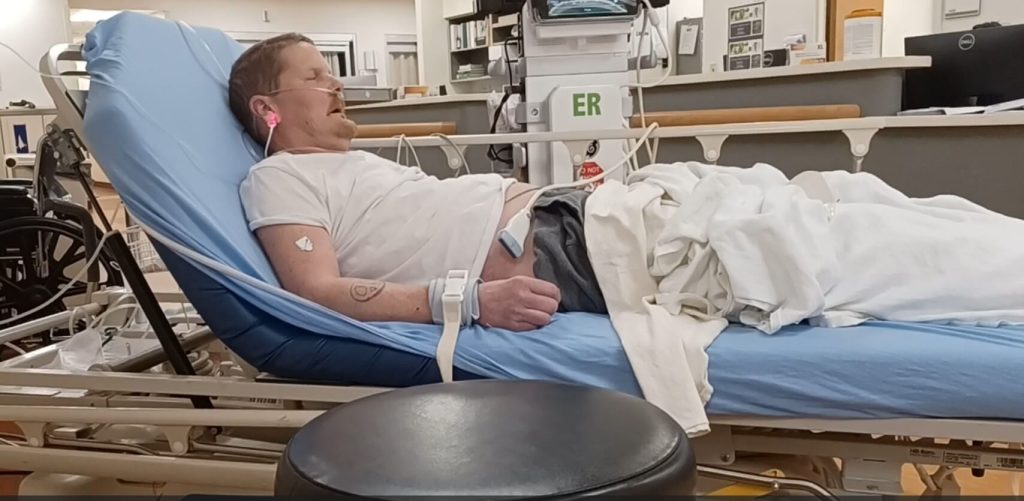
Wesley arrived at a hospital owned by a private equity firm. Instead of being evaluated and treated, he was strapped to a gurney and left in a public hallway for more than seven hours. No emergency medical screening. No treatment for the symptoms he came in with. No fluids. At shift change, his condition caused an argument among the staff.
What the hospital did instead of testing him for food poisoning was administer multiple drugs without my knowledge — and when the actions of the staff injured him, they didn’t tell us. We found out in September, 2023 when Wesley collapsed. He was rushed to the ICU a different hospital, and that is where we finally learned the truth: the hospital had caused acute kidney injury.
We only discovered how it happened because a document was faxed from the hospital that injured him to the ICU facility — a document that named exactly what was done and who did it. That document told us what the hospital had concealed. The hospital had already began concealing records on December 5, 2022, when I started asking questions and requesting his medical records. That was the moment everything changed.
What We Learned About the Hospital
As we dug into what happened to Wesley, we discovered a pattern that went far beyond our case. The hospital is owned by a private equity firm — one that has donated PAC money to our Governor, members of Congress, and Tennessee lawmakers. Its executives received millions in compensation while the hospital’s own revenue was diverted upstream through a securitization program designed to service billions of dollars in investor debt.
That financial structure left the hospital chronically understaffed. Wesley was not an anomaly. He was a consequence.
We brought this to the attention of Congress. Our complaint was passed around. Legislators expressed interest. And yet nothing has been done to stop private equity firms from using this model to extract revenue from community hospitals while patients pay the price in the emergency room.
Three Years of Fighting Back
Wesley and I were on the verge of launching our coaching business when this happened. We had to shut it down. Instead of building something, we have spent more than three years trying to hold a hospital system accountable — as self-represented litigants, with no legal background, going up against three law firms and eight attorneys whose strategy has been to delay, obstruct, and deny access to the very medical records that document what was done to Wesley.
We now have three active cases: two in federal District Court and one before the Sixth Circuit Court of Appeals. That appeals case carries implications beyond our family. We are directly challenging the courts’ use of a 1992 case — Cleland v. Bronson Health Care Group — that has been expanded far beyond its original scope to dismiss EMTALA failure-to-screen claims.
EMTALA is the federal law that guarantees every patient who walks into an emergency room, that is a part of the Medicare & Medicaid Program, the right to an appropriate medical screening examination. Strapping a patient to a gurney and walking away from them, depriving them of a $26 stool culture kit, and then testing multiple drugs on him is not an appropriate screening or stabilization. The hospital failed to transfer him to another facility so he could be tested and given fluids.
The debt instruments the investors are bound to requires their hospitals to transfer their revenue upstream. This is initiated when a patient (or their surrogate) signs the patient consent form. Patient consent form data is shared with the investors’ lenders, which gives the investors cash flow to pay debt and to borrow more debt. It’s a vicious circle that treats patients like stock certificates.
When courts misapply Cleland, they hand hospitals a tool to escape accountability before patients can ever obtain evidence of wrongdoing. We are asking the Sixth Circuit to correct that — and the outcome could affect patients across the circuit for years to come.
Where We Are Now
We are full-time campers — not by choice. After the hospital’s in-house collections operation destroyed our credit in retaliation for our persistent records requests, we lost our housing. We moved into a camper that is now literally falling apart. No campground will accept it in its current condition. I am allergic to mold, and there is mold. I cough a lot but we cannot get another loan for a better camper. We live on debt right now.
The property we are currently on is being converted to a parking lot, and we have to be gone by winter.
We cannot qualify for traditional housing. Every day is consumed by the stress of the cases, Wesley’s ongoing medical bills, and the reality of living in an economic situation where nutrition is expensive, and we don’t have a proper refrigerator or kitchen.
We are not quitting. We have a voice right now, in a court that matters, and we intend to use it. But we need help to survive long enough to see it through.
Why $48,000
The Sixth Circuit appeal alone could take nine months or more. We have a second federal case that the same judge is refusing to allow discovery, preventing the hospital from having to turn over evidence. This case might also go before the Appeals Court because they are aware of both cases.
Here is what this funding would provide:
- A reliable camper — An RV because we don’t have any way to pull the camper we have so we can move around if we can’t find land. One that is safe, mold-free, and accepted at campgrounds.
- A down payment on raw land in Tennessee — so we have a stable place to work and live through the duration of the litigation. This is our hope so we can have a garden, plant some fruit trees, and have easy access to nutrition.
- One full year of basic living and case expenses — nutrition, transportation, filing costs, and the time we need to keep fighting three simultaneous cases against eight opposing attorneys
We are not asking for comfort. We are asking for stability. Enough to stay in the fight.
What Your Support Means
When you support this campaign, you are not just helping us keep a roof over our heads. You are helping two ordinary people stand in a federal courtroom and argue that the law means what it says. That patients have rights. That private equity firms cannot be allowed to hollow out a community hospital, injure a patient, conceal it, retaliate against his family, and then get to walk away, because eight lawyers can benefit from a court that helps them escape turning over medical records.
If you have ever sat in an emergency room and trusted that the system would take care of you, this case is about you too. When you sign that patient consent form, is the hospital obligated to share it with the creditors so the investors can use debt to play in the New York Stock Exchange?
Please share this campaign even if you cannot give. Visibility is its own form of support. And if you are an attorney, an organization, or someone with resources who wants to be part of this fight in a larger way, please visit our website for more information.
We are exhausted, but we are not done.
— Wesley & Colleen