
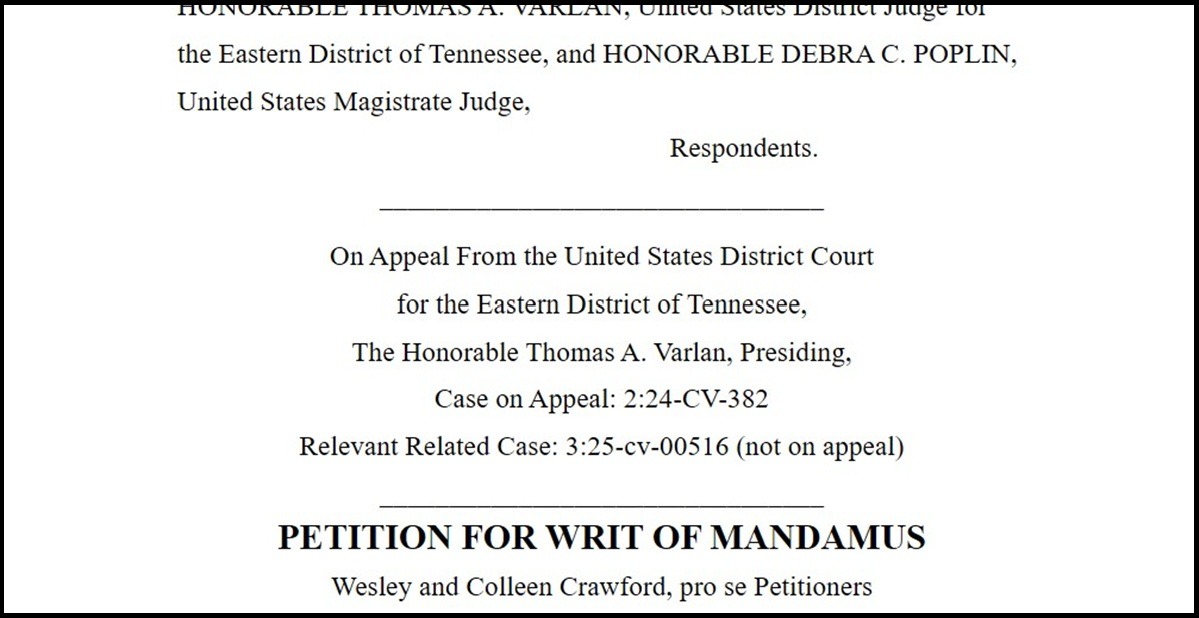
We filed a petition for writ of mandamus because the district court delayed our access to the Sixth Circuit Court of Appeals. On September 25, 2025, we filed our notice of appeal, and a motion to proceed in forma pauperis.
For 159 days, the District Court would not rule on the IFP, so we filed a Petition for Writ of Mandamus on March 3, 2026. As of May 7, 2026, we are still waiting for a ruling.
See below the introduction for the full writ, appendix, and the supplemental notice.
I. INTRODUCTION
Petitioners Wesley E. Crawford and Colleen A. Crawford, proceeding pro se, respectfully petition this Court, pursuant to Federal Rule of Appellate Procedure 21 and 28 U.S.C. § 1651, for a writ of mandamus directing the United States District Court for the Eastern District of Tennessee (Hon. Thomas A. Varlan and Hon. Debra C. Poplin) to promptly rule on Petitioners’ motion to proceed in forma pauperis (IFP) on appeal.
Petitioners seek an order directing the District Court to rule on Petitioners’ Motion to Proceed In Forma Pauperis (IFP) on appeal, which has remained pending for more than 150 days.
This extraordinary delay effectively denies Petitioners access to the appellate process. While the District Court has stalled the current appeal, it continues to advance a related case involving the same parties (Case No. 3:25-cv-00516), creating the same unfair procedural advantage for the defendants in that case that was created for them in the case on appeal.
Because an IFP ruling is a mandatory prerequisite to the transmission of the record, the District Court’s inaction has created a procedural “dead zone” where Petitioners have no other adequate means of relief. Petitioners ask this Court to compel a ruling—whether a grant or a denial—so that their appeal may proceed.
The magistrate judge recommended that Petitioners’ IFP be denied, finding that their notice of appeal lacked information to determine if their appeal was frivolous.
Petitioners’ responded to the Court’s R&R by providing details of the issues they intend to raise on appeal, which they believe are not frivolous, including, but not limited to:
1. Whether the district court erred in dismissing state-law and EMTALA claims at the pleading stage,
2. Whether the district court disregarded § 455,
3. Whether the district court erred in using Cleland v. Bronson to require an improper motive not found in EMTALA’s text,
4. Requesting en banc review of Cleland v. Bronson